If you’ve been running a business for any length of time, you’ve probably had this thought at least once: what if I just stopped posting?
Not stopped marketing all together. Stopped doing it through social media. Stopped feeding an algorithm that shows your posts to a fraction of your followers. Stopped spending hours playing graphic designer for content that disappears in 48 hours.
The good news is that quitting, or at least reducing, social media is a real option for a lot of small businesses. The even better news is that the channels that replace it tend to be more reliable, more measurable, and a lot less exhausting.
Can You Grow Your Business Without Social Media?
Before we get into that: if you’re an influencer whose income comes from brand deals and platform collaborations, social media isn’t optional — it’s literally your product. But most small business owners, especially service providers, aren’t in that category. We make our money providing services, products, and expertise. Somewhere along the way, we started trying to market like influencers, becoming full-time content creators on the side, when that was never the job.
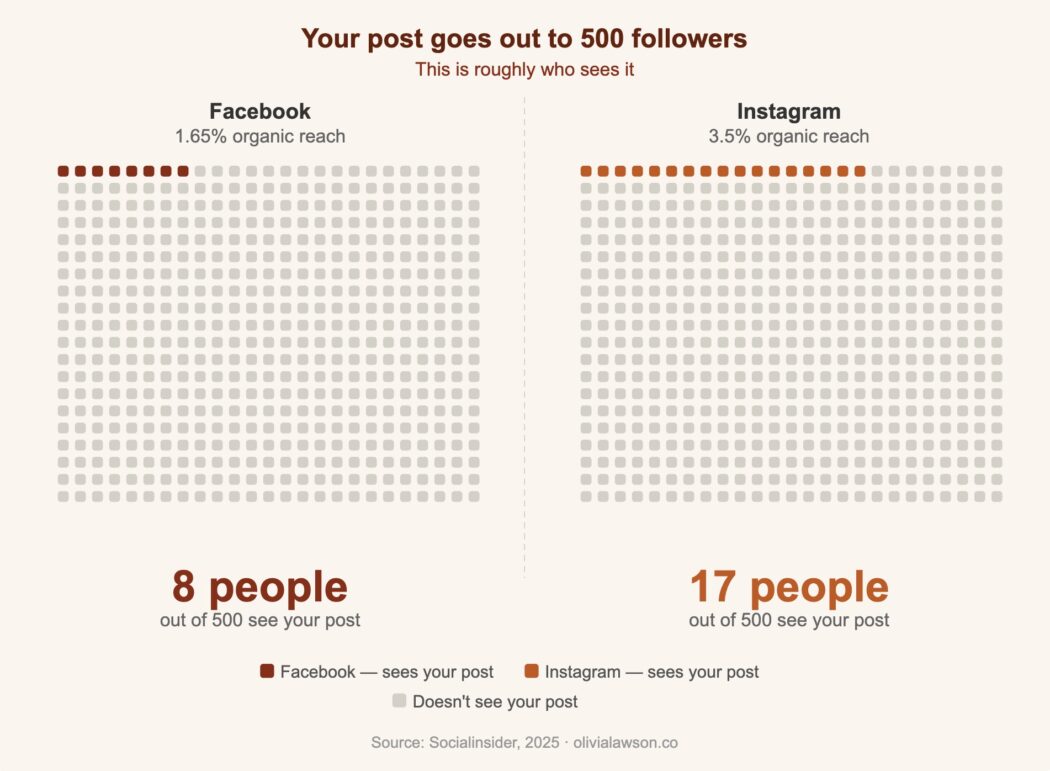
Social media platforms have conditioned us to think they’re essential. For most of us, they’re not. Instagram’s average organic reach sits at around 3.5% of your followers. Facebook is even lower, closer to 1.20% for 2025. That means if 500 people follow you, somewhere between 8 and 17 of them actually see any given post. On a good day.
A lot of small businesses are quietly quitting social media and are instead choosing to generate most of their leads through search, referrals, email, and yes, paid ads. They just don’t talk about it because there’s no viral moment in “our SEO finally kicked in” or “most of my clients are referrals”.
That said, social media doesn’t have to be completely off the table. If you enjoy it, or if it genuinely brings you leads, keep it! There’s also value in having a social presence for AI visibility. Public posts and brand mentions feed into how AI tools like ChatGPT and Google’s AI Overviews describe and recommend businesses, so it’s not without value.
What matters is that your marketing doesn’t depend on it. The strategies below all work whether you’re posting on Instagram daily (bless), weekly, or not at all.
The 7 Marketing Channels Worth Your Time
1. SEO — the foundation everything else builds on
SEO is how your website shows up when someone searches for what you do. It’s not magic, and it doesn’t happen overnight — but it’s one of the few marketing investments that compounds. A page that ranks well today will keep generating traffic next month, next year, and beyond, without any additional effort on your part.
The basics are simpler than most people think: make sure each page on your website has a clear title that matches what people are searching for, a meta description that tells them what they’ll find, and content that actually answers their questions. Most small business websites have room for improvement here before even thinking about creating new content.
Honest timeline: expect 3–6 months before you see meaningful movement. It’s a long game, but it’s one worth playing. If you’re starting from scratch and your site isn’t showing up at all, this is a good place to start.
2. Blogging — but only if you do it with a point
Everyone tells you to start a blog. Almost no one tells you what to write. What works is writing about the specific things your customers are searching for.
That means before you write anything, you need to know what questions your potential clients are typing into Google. Answer those questions well, on a regular basis, and Google starts to see your site as a useful resource. Each post is essentially another door into your website — and unlike a social media post, it stays open indefinitely.
The compounding effect is real here. Three posts become ten, ten become twenty, and the traffic from all of them adds up over time.
3. Your Google Business Profile
If you’re a local or service-area business, this is where I’d tell you to start before anything else on this list, and it’s completely free.
Your Google Business Profile is what shows up when someone searches for your business by name, or when they search for something like “accountant near me” or “plumber in [your city].” Done well, it puts you directly in front of people who are actively looking for what you do, often with credit card in hand.
The difference between GBP traffic and most other traffic is intent. Someone clicking through from your GBP listing isn’t browsing. They’re shopping.
I’ve written a full guide to optimizing your Google Business Profile — it’s worth an afternoon of your time.
4. Email marketing
Most people think of email as a way to keep existing customers warm. That’s true, but it’s also one of the best ways to drive people back to your website, which is where most of the actual decision-making happens.
Every email you send is a traffic spike. Link to a new blog post, a service page, a case study — whatever’s useful. The click lands on your website, where your copy, your credibility, and your offers can do their job.
The other reason email matters: you own it. Your Instagram following can evaporate overnight if the algorithm changes or the platform loses favor. Your email list is yours regardless of what any tech company decides to do next.
Building a list without social media is simpler than it sounds: a useful freebie on your website, an opt-in form, and some consistent value-first emails. That’s the whole system.
5. Referrals
Referrals feel passive until you realize they can be systematized. Most small business owners get referrals occasionally, but few actively build a process around them — which means they’re leaving a significant amount of business on the table.
A simple follow-up email after a positive client experience, asking if they know anyone who might benefit from the same help, works better than most people expect. Relationships with complementary businesses who serve the same clients are another underrated source. A bookkeeper who refers clients to a marketing consultant. A wedding photographer who has a standing relationship with a florist. These connections are worth cultivating.
One good client can bring five more. It just takes a little intentionality.
6. Guest content and partnerships
Getting in front of someone else’s audience whether through a guest blog post, a podcast appearance, or a newsletter feature is one of the faster ways to build awareness without starting from scratch.
The trust transfer here is real. When a podcast host introduces you to their audience, or when a publication you respect publishes your piece, you’re borrowing credibility that would otherwise take months to build on your own. That audience arrives warm, not cold.
The pitch doesn’t have to be complicated. Find platforms where your potential clients already spend time, think about what you could offer their audience that would be genuinely useful, and ask.
7. Google Ads — when you need results now
Every other strategy on this list takes time. Google Ads is the exception.
With a well-run campaign, you can be showing up at the top of search results for your most valuable keywords within days — not months. The traffic is high-intent (people searching for exactly what you offer), and the results are measurable in a way that most marketing isn’t.
That said, it’s not a magic fix. It requires a real budget, proper setup, and someone paying attention to the data. When those things are in place, it’s the most direct path from “nobody can find me” to “my phone is ringing.” And it works well alongside organic strategies — while SEO is building momentum in the background, ads can keep leads coming in the door IF your business is ready for Google Ads.
Which one should you start with?
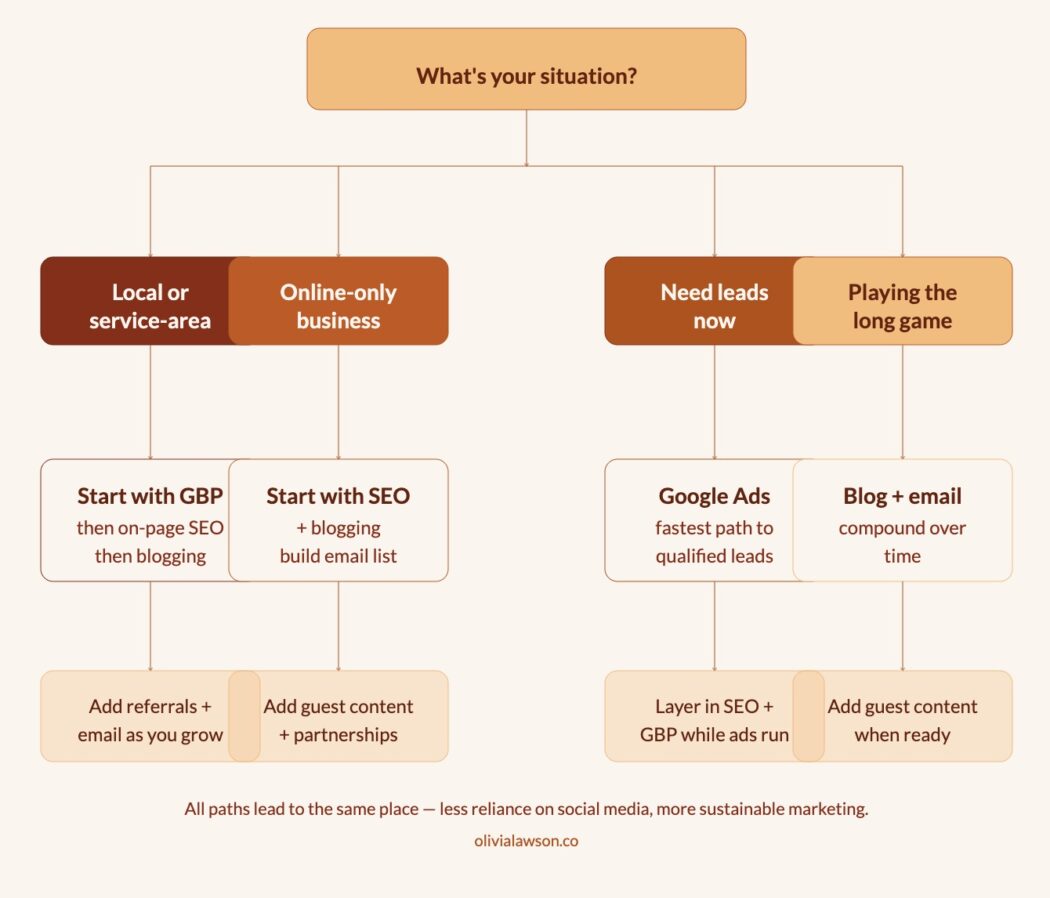
It depends on your situation.
Local or service-area business? Start with your Google Business Profile, then clean up your on-page SEO. These two things alone can have a big impact on your visibility in local search.
Online-only business? Start with SEO and blogging. Build your email list in parallel — a lead magnet and an opt-in form on your website is all you need to get started.
Need leads in the next 30 days, not the next 6 months (and willing to pay)? Google Ads is probably the answer. Organic strategies are worth building, but they won’t solve an immediate pipeline problem.
Playing the long game? Blogging and email are your best compounding assets. Consistency matters more than volume. Two good blog posts a month beats eight mediocre ones.
One more thing worth noting
How you get found online is changing. More people are getting answers directly from AI tools — ChatGPT, Perplexity, Claude, Google’s AI overviews — rather than clicking through to a list of search results. This isn’t a reason to panic, but it is a reason to make sure your content is clear, structured, and useful. AI tools surface content that directly and specifically answers a question. This is also why it’s important to focus on more than just 30 second reel content.
The good news: if you’re creating people-first content that’s helpful, reliable and prioritizes the needs of your audience; you’re already doing the right thing.
Final Thoughts
Marketing without social media requires making deliberate choices about putting your time and money into channels that compound, channels you own, channels where the people you’re trying to reach are already looking for you.
Some of these take time to build. Some can start working quickly. But all of them are more sustainable than trying to keep up with an algorithm that changes every few months.
If you’ve dialed in your organic channels and are ready to explore paid search channels, let’s have a chat about about how Google Ads could profitably impact your business.
FAQs About Marketing Without Social Media
How long does it take to see results from marketing without social media?
It depends on the channel, but plan for a mix of fast and slow. Google Ads can start sending traffic within days. Your Google Business Profile can show improvement within a few weeks if it wasn’t optimized before. SEO and blogging are the slow burners — usually 3 to 6 months before you see real movement, sometimes longer depending on your industry and competition.
Do I need to completely quit social media to use these strategies?
No. None of this requires you to delete your accounts or swear off posting forever. The point isn’t that social media is bad, it’s that it shouldn’t be the only thing holding up your marketing. Plenty of business owners keep a light social presence, post when they feel like it, and let these other channels do the heavier lifting. If you enjoy social media or it brings you business, there’s no reason to stop. Just don’t let it be the only plan you have.
What’s the biggest mistake small businesses make when trying to market without social media?
Trying to do everything at once. Someone decides social media isn’t working, reads a list like this one, and tries to start SEO, blogging, email, GBP, and guest posting all in the same week. That’s a fast way to burn out and abandon all of it within a month. The businesses that actually pull this off pick one or two channels that fit their situation, get those working, and add more over time. Slow and consistent beats fast and scattered, every time.