
If you’ve ever asked “do Google Ads work”, then you’ve probably heard two completely different things about Google Ads from two equally confident business owners.
One person swears Google Ads transformed their business. Another says they burned through thousands of dollars and got nothing. Both are telling the truth. That’s not a contradiction. And it’s exactly why this question is so hard to answer with a straight yes or no.
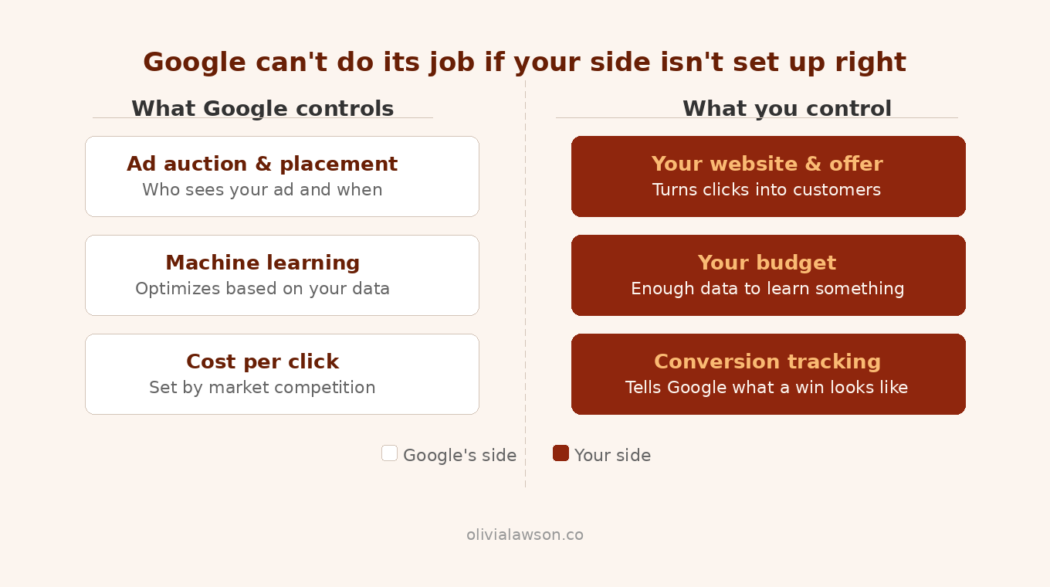
The person who got great results and the person who got burned aren’t having randomly different experiences. Google Ads is essentially a paid line at the front of search results. When someone types in what you offer, your ad shows up. They click, they land on your website, and then your website has to do its job. If any part of that chain is broken, the targeting is off, the budget is too small, the website doesn’t convert, or there’s no way to track whether any of it worked, failure is almost a given.
That’s not a Google Ads problem. That’s a setup problem. And it’s more common than most ad managers will admit.
The businesses that see strong results aren’t necessarily smarter or luckier. They went in with the right foundation, realistic expectations, and usually someone optimizing the account for performance.
I’m not here to sell you on Google Ads but I am here to help you figure out if they’re right for you, including the part where it doesn’t make sense.
Factors beyond Google Ads that determine whether they “work”
Before running a single ad, there are a few things that matter more than your ad copy or which keywords you pick.
1. People need to be searching for you what you sell.
Google search ads work because they show up when someone is actively searching for something. Not when they’re doomscrolling socials, and may or may not be in the market for your product or service. If you sell something most people don’t even know to search for, search ads aren’t the right fit and social media ads might be better suited for that.
2. Your website has to be able to do its job with the traffic.
Here’s the thing with paid traffic that most pros don’t want to tell you. It’s not enchanted. If your website isn’t already turning visitors into customers, more traffic won’t fix that. The ad gets people to the door — what’s behind it has to do the rest.
3. Your budget needs to be high enough to learn something.
This is the one that trips people up most. A small budget in a competitive market might get you a handful of clicks per week, but that’s just not enough data to be useful. You don’t need an unlimited budget. Google’s machine learning needs enough clicks and conversions to figure out who to show your ads to. Too little data or not the correct data and it’s just guessing.
Side quest: What the heck is machine learning? I’m a math nerd but I promise we’re not getting into the weeds here. The only thing you really need to understand about machine learning is it’s a type of predictive modeling used in many ad platforms. As in it can be used to predict which type of home owner is ready to hire a contractor for home renovations or a business owner ready to hire for a commercial build-out.
4. You need to be able to track results.
If you can’t tell whether a new lead or customer found you through an ad, you’ll never know if it’s working. This sounds basic, but missing or broken conversion tracking is one of the most common mistakes I see. Conversion tracking is simply how Google records when someone takes a real action: fills out a form, makes a call, completes a purchase. Without it, you’re just guessing — and so is Google. The predictive nature of machine learning we discussed above is exactly what makes conversion tracking worth doing right.
Google Ads don’t work for every business
Highly regulated industries like healthcare, med-spas, supplements, and financial services can be flat-out tough to market for. Not to say it’s impossible. I’ve successfully managed campaigns for almost all of the categories mentioned above but it does take a strategic approach, crystal clear expectations and a decent budget.
Ultra competitive markets like Los Angeles, San Francisco, New York, and fitness in general can be cost-prohibitive for most small businesses. It takes a solid foundation, focused strategy and clear results tracking to make it work. It’s not impossible though.
Case in point: Alyse is a lifestyle photographer in San Francisco, one of the most competitive markets for photographers in the country. She’d been running her own Google Ads for years, spending real money, with no way to track if any of it was working. Once the right foundation was in place, Google Ads went from one of her lead sources to her number one source — and she was booked out months in advance within 30 days. Competitive markets are winnable. They just don’t forgive a sloppy setup.
Even if you’re not in a regulated or highly competitive market, Google Ads might not be the best approach for your business. If your margins are very thin, the math on paid ads can be nearly impossible to make work. If you’re still working on your offer or sales process, ads will magnify whatever gaps currently exist. A website that’s struggling to convert visitors? Same story.
None of that means your business isn’t good. It just means Google Ads isn’t the right tool, right now.
What does a “successful” Google Ads campaign look like
Here’s a soap box I’ll stand on again and again. Clicks and impressions tell you something, but they don’t tell you whether you made money.
Successful ads mean a real customer came in, you made money, and what you spent to get them was less than what they were worth to your business.
That’s it. Everything else is context for understanding whether your ads are getting you that result.
If you can measure that clearly, you can make smart decisions about whether to keep going, adjust or stop. If you can’t, no amount of clicks, impressions, or a pretty dashboard is going to tell you what you need to know. Those numbers don’t pay your bills. Customers do.
So where does that leave you?
If you read this and most of it applies to your business — people are searching for what you sell, your website works reasonably well, and you have a budget that’s realistic for your market — Google Ads is worth exploring. Not sure what realistic looks like for your market? That’s a conversation worth having before you invest in ad spend.
If some of it doesn’t apply yet, that’s useful to know too. It’s better to figure that out now vs. three months into a campaign.
If you’re still not sure where you land, I’m happy to help you think it through. No pitch, just an honest conversation about whether it makes sense for your specific business.
FAQs about Google Ads for Small Businesses
How much should a small business budget for Google Ads?
There’s no universal number, and anyone who gives you one without knowing your market, industry, and goals is guessing. What I can tell you is that the budget needs to be high enough to generate enough clicks to learn something. In competitive markets like home services or legal, that bar is higher. In less competitive niches, you can get meaningful data for less. Budget is one of the first things I help clients think through.
How long does it take for Google Ads to start working?
It depends on your budget and how competitive your market is, but generally you should expect a learning period of 30-90 days before you have enough data to make informed decisions. Ads aren’t a light switch. The first month is often about gathering data and controlling cost. If someone promises you instant results, that’s a red flag.
Do Google Ads work for local businesses?
Yes. Local businesses are some of the best candidates for Google Ads, when the setup is right and the budget is realistic for their market. Think about it, if you’re looking for a photographer to take family portraits, you’re past wondering if family portraits are worth paying for. You’ve already decided they are. Now you’re searching for the right local fit.
What’s the difference between Google Ads and SEO? Do I need both?
SEO builds visibility over time. It’s slower but free once it’s working. Google Ads buys you visibility immediately — you pay per click, but you show up right away. They work well together, but if your website isn’t converting organic traffic yet, that’s worth fixing before adding paid traffic into the mix. I usually recommend getting your organic foundation solid first.